Demonstration of Eating, Licking, and Drinking

Demonstration of Eating, Licking, and Drinking, 2012

This is one of my all-time favorite images. When I showed it to filmmaker Werner Herzog, he concurred and added that he believed it belonged “next to the Mona Lisa.”

Demonstration of Eating, Licking, and Drinking was produced by a team of scientists at Cornell University to be included on the Voyager Golden Record, a collection of images and sounds encoded on an LP record and attached to the hull of the Voyager spacecraft. The record was intended to explain something about life on earth to any extraterrestrials that might come across the spacecraft.

Demonstration of Eating, Licking, and Drinking was meant to be an unambiguous representation of how humans consume food. The photograph “presents a great deal of information about how our mouths work,” explained astronomer Carl Sagan, who spearheaded the Golden Record project.

In other words, the image was created by some of the worlds most renowned scientists to be so clear and universal that even an alien in the depths of space could understand it.

What they ended up with – in my opinion – is an image that rivals Magritte and Dali in its surrealism. I take this as an allegory about the nature of images themselves – that images have their own lives and sometimes the more you try to pin them down, the faster and further they will run away from you.

It Began as a Military Experiment

Contemporary research into facial recognition technology began in earnest in the mid-1990s at the behest of DARPA, the Defense Advanced Research Projects Agency. The military wanted facial recognition to exist, so DARPA began funding researchers in computer science and computer vision to work on the problem.

It Began as a Military Experiment, 2017
Set of 10 pigment prints
13 ⅝ × 10 ½ in.

The military realized that to do facial recognition, researchers would need to have access to thousands of images of peoples’ faces. So in the early 1990s the military funded the creation of something called the FERET database, which included tens of thousands of pictures of many thousands of people, most of whom worked at a military base in Maryland. This work was made by combing through the FERET database over many months to “curate” a selection of portraits, to retouch and color correct them, and run them through an algorithm that identifies the keypoints in their faces. One of the ways I think about these portraits is as a kind of super-structuralism in the sense that they are images that were not made for human eyes. They are made for machine eyes. What’s more, these photos represent some of the “original-faces” of facial recognition – the “Adam and Eves” that nearly all subsequent facial recognition research has been built upon.

It Began as a Military Experiment, 2017
Set of 10 pigment prints
13 ⅝ × 10 ½ in.
Detail

Contrails

Contrails
(R-4808N Restricted Airspace, Nevada), 2012
C-Print
48 × 60 in. 

Two condensation trails from unknown aircraft flying within the borders of the Air Force’s R-4808N Restricted Airspace. The R-4808N airspace is a section of classified airspace within a larger swath of restricted airspace in central Nevada. Uncleared military pilots inadvertently flying into “the Box” or “the Container” (as they call the ultra-restricted airspace) during war-game and training exercises – even in the case of an emergency – face severe disciplinary action.

Angelus Novus

Angelus Novus, 2012
C-Print
42 ¼ × 34 ½ in.

Philosopher Walter Benjamin’s last essay, On the Concept of History, excoriates the notion of “progress.” For Benjamin, history is not a linear march led by great men towards a glorious future, but a circular series of endless catastrophe, where we repeat the same humanitarian, political, and economic crises over and over.

Benjamin illustrates this idea by way of a drawing he owned, Paul Klee’s Angelus Novus. For Benjamin, the drawing represented what he called an angel of history, watching us with outstretched wings, being thrown backwards into the future by the endless explosions of the present.

This is a photograph of that back of Paul Klee’s Angelus Novus, once owned by Walter Benjamin and now residing in the Israel Museum.

It is also the first photograph in The Last Pictures collection, currently in geostationary orbit, 36,000km over the Atlantic Ocean.

Karnak

I often think about the different histories of photography – how they intersect and diverge and how so much necessarily gets left out by any attempt to tell a coherent story about the history of the medium. I think a lot about the various histories of photography in the western US – a history of photography being part of military surveys and documentation of wars against indigenous peoples. 

I wrote an essay for Art Forum a while back about this.

If I were to update that essay, I’d talk about how things like drones, autonomous weapons, AI vision systems, and computer vision in general are part of this history of photography that interlaces forms of mechanical “seeing” with state power, colonialism, technology, extraction, and dispossession. 

Warm Spring Indian Scouts in camp Muybridge, Eadweard, 1830-1904.
“Karnak” Montezuma Range, Nevada T.H. O’Sullivan.

Karnak is from a body of work that looks at 19th Century photography in the western US in relation to contemporary forms of computer vision and AI. Trying to think through some of the histories of image-making, technology, extraction, and colonialism that create a thread from contemporary Silicon Valley to 19th Century survey photography.

The place is a weird ridge in Nevada that was photographed by Timothy O’Sullivan on the Wheeler “reconnaissance” survey of the west in 1867 – O’Sullivan’s image is one of my all-time favorite photographs ever made. 

It took me years to find this place – rummaging around the desert over many summers. One time I thought I’d found it. The problem was that it got dark and there was no trail and I only knew that my truck was about 2 miles north of me parked on a dirt road that was perpendicular to the direction I’d hiked. I had to follow the north star (good thing I had to learn how to read the sky from photographing satellites). I have to admit I never actually found the site. I was talking to Bill Fox one day and mentioned my ongoing quest, and he told me he’d been there with Mark Klett. Bill put me in touch with Mark, who very generously gave me the GPS coordinates – Mark had found the site as part of his “Third View” project with Byron Wolf. 

The image is made with an 8×10 camera, whose film has been scanned and run through the computer vision software that we built in my studio and then printed as a traditional gelatin silver print.

Karnak, Montezuma Range
Haar; Hough Transform; Hough Circles; Watershed, 2018
Silver gelatin LE print
Triptych, each element: 80 × 39.9 in.
Overall size: 81 ½ × 121 in.

Drones

This is a series of photographs of the skies in the Nevada desert. American military and intelligence drones all over the world are flown by pilots here (at places like Creech Air Force Base and “Area 52”) via satellite uplink. In these prints, small Predator, Reaper, and Sentinel drones dot the skyscapes.

Untitled (Reaper Drone), 2010
C-Print
48 × 60 in.
Untitled (Reaper Drone), 2015
Pigment print
48 × 60 in.
Untitled (Reaper Drone), 2013
C-Print
48 × 60 in.
Untitled (Reaper Drone), 2010
C-Print
48 × 60 in.
Untitled (Reaper Drone), 2013
C-Print
48 × 60 in.
Untitled (Sentinel Drone), 2014
C-Print
20 × 25 in.
Untitled (Sentinel Drone), 2014
C-Print
20 × 25 in.
Detail

The Last Pictures

This project was inspired by an image that came from my work tracking secret satellites. Over the course of my work on satellites, I realized that certain kinds of satellites – those in geosynchronous orbits – experience virtually no drag from the atmosphere below and consequently stay in orbit for extremely long amounts of time – millions or billions of years. I realized that it’s entirely possible that one day in the distant or not-too-distant future, when humans are long extinct, a ring of dead satellites will continue circling the planet in perpetuity.

The Last Pictures Artifact, 2013
Golden disc
8 × 8 × ½ in.

The Last Pictures is an artifact placed onboard a satellite called EchoStar XVI which will inhabit a cosmic “graveyard” approximately 36,000 km away from earth for long into the distant future. A kind of space-based monument to the Anthropocene, The Last Pictures contains a hundred images that speak to some of the alterations humans made to the planet.

The Last Pictures, 2012
Mosaic of included images.

The project was developed with Creative Time and was produced in part at MIT.

In November 2012 EchoStar XVI launched from Baikonur, Kazakhstan and reached geostationary orbit with The Last Pictures mounted to its anti-earth deck.

Timeline of Earth History, 2012
The Last Pictures, 2012
Documentation of artifact placed on Echostar VXI Satellite.
The Last Pictures, 2012
Documentation of proton rocket launch preparation.

A book about the project and some of the philosophical and ethical issues related to it is available from UC Press.

A free-standing website for the project is here.

Trinity Cube

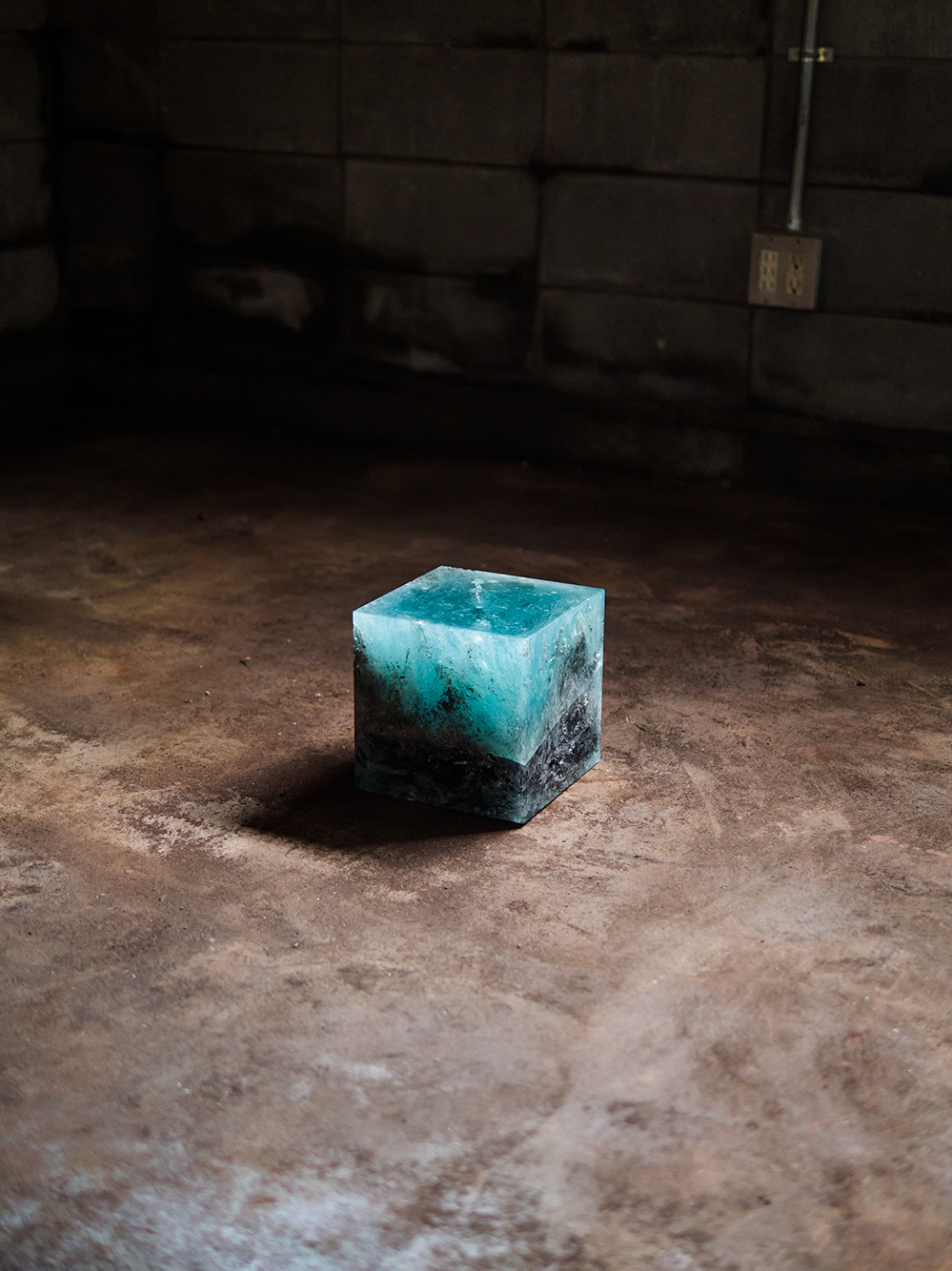
Irradiated broken glass collected from inside the Fukushima Exclusion Zone forms the outer layer of this sculpture. The work’s inner core is made out of Trinitite, the mineral created on July 16, 1945 when the United States exploded the world’s first atomic bomb near Alamogordo, New Mexico, heating the desert’s surface to the point where it turned surface sand into a greenish glass.

Trinity Cube was created by melting these two forms of glass together into a cube, then installing the cube back into the Fukushima Exclusion Zone as part of the Don’t Follow the Wind project. The artwork will be viewable by the public when the Exclusion Zone opens again, anytime between 3 and 30,000 years from the present.

Trinity Cube, 2015
Irritated glass from Fukushima Exclusion Zone, Trinitite
7 ⅞ × 7 ⅞ × 7 ⅞ in.
Installation view, Fukushima, Japan, 2015 – ongoing.

Trinity Cube, 2015
Production documentation.
Map of Fukushima exclusion zone.

Trinity Cube, 2015
Production documentation.

Excavating AI

Trevor Paglen, Kate Crawford, Excavating AI, 2019

This is an article that I co-authored with my friend and collaborator Kate Crawford, who directs the AI Now Institute at NYU. In the article we take a look at some of the bad assumptions and bad politics built into the architecture of the training data used in AI systems.

The X-37B

The American Air Force’s secretive X-37B space-plane-drone is back after it’s fifth mission in orbit. There’s some controversy about whether it deployed an array of small secret satellites in violation of the United Nations’ Registration Convention, which says that all countries have to report on the satellites they put into orbit. 

X-37B/OTV-3 in Gemini (Orbital Test Vehicle, “Space Plane”; USA 240), 2013
C-Print
60 × 85 in.

I photographed the X-37B in 2013 when it was on its third mission and have some other materials related to it.

This is one of the patches associated with the program, which I got from my friend Marko Peljhan and which is included in one of the “Symbology” collections.

My friend Peter Merlin designed this patch during the testing phase of the X-37 at Edwards AFB in California. The full story behind it is in the “From the Archives of Peter Merlin” book that we published in Spring 2019.