Cyclops is a networked performance, collaborative narrative, and alternate-reality-game designed to be played by groups of people working together across the word. Set in the late 1960s and early 1970s, the game begins with a series of audio tracks. Some tracks are musical compositions, others are filled with odd voices reading letters and counting numbers, others still resemble nothing more than noise and static. Each track is, in fact, a puzzle of increasing complexity. As players work together to solve them, a narrative about early research into psychological operations, mind-control experiments, and an alternative history of the internet age begins to emerge. Over the course of the game, players come across a collection of artworks that are specifically created for Cyclops players. To find these artworks, players must identify and follow up on clues provided within the game. Cyclops is a world within a world.
CYCLOPS, 2023
A portal to access Cyclops can be found at cyclops.sh, and more information about the project can be found here.
This post is part of a series of posts supporting works from the exhibition You’ve Just Been Fucked by PSYOPS at Pace Gallery, New York.
You can find more information about this project and other posts in the series here.
As part of his training to join the Air Force Office of Special Investigations (AFOSI), Richard Doty was taught how to recruit spies, conduct and resist interrogations, run surveillance operations, and organize and manage deception and disinformation campaigns. After graduation, he was assigned to Kirtland Air Force Base in Albuquerque, NM.
Doty, 2023 (Still from video) Single channel video projection, black and white, stereo mix 66 min (loop)
During his active years in the late 1970s and 1980s, all sorts of strange, cutting-edge projects were taking place at the airbase. There were experimental laser systems, nuclear weapons programs, highly classified “stealth” aircraft, and other advanced technology demonstrators. Bizarre light shows, unearthly radio transmissions, and impossible-to-explain events became a mainstay in the base’s vicinity. Civilian UFO researchers took notice and began to investigate the goings-on at Kirtland.
Using his training in counterintelligence, deception, and spycraft, Doty would recruit people from the UFO community to act as informants for the Air Force, and to assist him in crafting and spreading disinformation among their ranks as part of his mission to protect Air Force assets.
Doty concedes that the field of UFO research is filled with charlatanism and disinformation, but nonetheless insists on the reality of the phenomenon. Over the course of his intelligence work, Doty describes being “read into” a top-secret program having to do with the US Government’s relationship to the UFO phenomena.
This post is part of a series of posts supporting works from the exhibition You’ve Just Been Fucked by PSYOPS at Pace Gallery, New York.
You can find more information about this project and other posts in the series here.
One genre of “outsider art” I’m most interested in is the unit patches and other emblems that military special operations groups and “black” units wear on their uniforms. These can be rare glimpses into some of the niches of military culture. One of the sculptures in my new body of work is inspired by designs made by PSYOP units…
Because Physical Wounds Heal…, 2023 Mixed Media 50 × 50 in.
The latin inscription on the sculpture is a translation of a slogan widely used in PSYOP units: “You’ve just been fucked by PSYOP. Because physical wounds heal.” A second message on the sculpture’s outer ring is available for viewers to attempt to decode.
Throughout their history, PSYOP units have conducted missions such as Operation Wandering Soul, which involved making audio recordings of “ancestral ghosts” that were played from loudspeakers in patrol boats and helicopters during the Vietnam war. In the 1980s, the Air Force Office of Special Investigations worked with Richard Doty to generate deception campaigns intending to manipulate and monitor UFO investigators.
Here’s the basic “generic” PSYOP crest. The figure of the horse is common in PSYOPS iconography. It has two meanings. The “knight” chess piece moves in a circuitous fashion and can attack from behind enemy lines. The second is a reference to the myth of the Trojan horse. The lightning swords are represent the ability to strike quickly.
Another figure commonly associated with PSYOP is the ghost. This references the “Ghost Army” of World War II, a group that conducted large-scale deception operations using inflatable tanks and materiel, loudspeakers and radio broadcasts, fake “generals,” and other ruses designed to make things appear that weren’t there. The “Ghost Army” was staffed by painters, designers, and architects including artist Ellsworth Kelly and fashion designer Bill Blass.
The ghost logo is still very much in use, sometimes in connection with the figure of the horse.
Things get lively pretty quickly when you start looking at PSYOP iconography… Here’s the logo for the 304th PSYOP company based out of Sacramento, CA.
Here’s a patch for the 609th Air Operations Center, based at Al Udeid Air Base, Qatar, and Shaw Air Force Base, South Carolina. The slogan here is along the lines of “to sweat, to change, to destroy…” The artwork is taken from a popular youtube meme.
And of course we find the usual grim reapers and other D&D imagery:
In 2011, the Army tried to change the name PSYOP to MISO (Military Information Support Operations). SecDef Robert Gates said “the term PSYOP tends to connote propaganda, brainwashing, manipulation, and deceit” and thought it was a bad look. The rank-and-file revolted – they didn’t like having the same name as a bowl of soup. In 2017, the Army changed it back to PSYOP. https://www.armyupress.army.mil/Journals/Military-Review/Online-Exclusive/2018-OLE/Mar/PSYOP/
People have had a lot of fun making meme designs around PSYOP…
Of course, the art of PSYOP isn’t primarily about making patches, and it’s not a coincidence that artists have been involved in it from the beginning.
In the past decade, online psychological operations have become ubiquitous. The documents leaked by Edward Snowden included information about a British unit called the “Joint Threat Research Group,” which hired prominent psychologists to aid its online efforts to destroy their target’s reputations and to manipulate online communities and discourse.
The JTRIG slide deck describes the dynamics that contribute to sociality, a sense of belonging, a sense of purpose, and explains how to weaponize those dynamics in order to fracture targeted individuals and communities. It also goes into the relationship between the physiological, psychological, and cultural dimensions of perception and shows how those too can be weaponized. The deck describes techniques utilizing everything from magic tricks to a belief in UFOs in order to persuade targets to believe or act in one way or another.
For more recent examples of the relationship between PSYOPS and aesthetics, consider the infamous “Ghost in the Machine” video produced by the 4th PSYOP Group: https://www.youtube.com/watch?v=VA4e0NqyYMw
And for a critical reading of how the aesthetics and politics of PSYOPS is all-too-real, check out these essays by @gunseli_yal and and @ja_ak_rtgr
And for a deeper dive into the wheels-within-wheels logic of possible PSYOP media, seehttps://youtu.be/JFlB2lVPoWo perhaps an example of where the logic of PSYOP is going…
This post is part of a series of posts supporting works from the exhibition You’ve Just Been Fucked by PSYOPS at Pace Gallery, New York.
You can find more information about this project and other posts in the series here.
In late October, 1962 an American fighter jet out of Key West screamed south towards Havana Bay. The reaction was almost immediate: the Cuban military scrambled a pair of interceptors and raced north to meet the intruder. Just as the American jet neared the coastline, it banked north, flying impossibly fast and remaining just out of Cuban pilot’s visual range. In the meantime, out of nowhere, a handful of unidentified aircraft of varying shapes and sizes appeared just outside the bay…
There was one problem. None of it was real. The plane was an electronically-generated “ghost.” The UFOs were a collection of specifically-calibrated balloons launched from an American submarine, carefully designed to appear on radar screens as something wholly different than what they actually were.
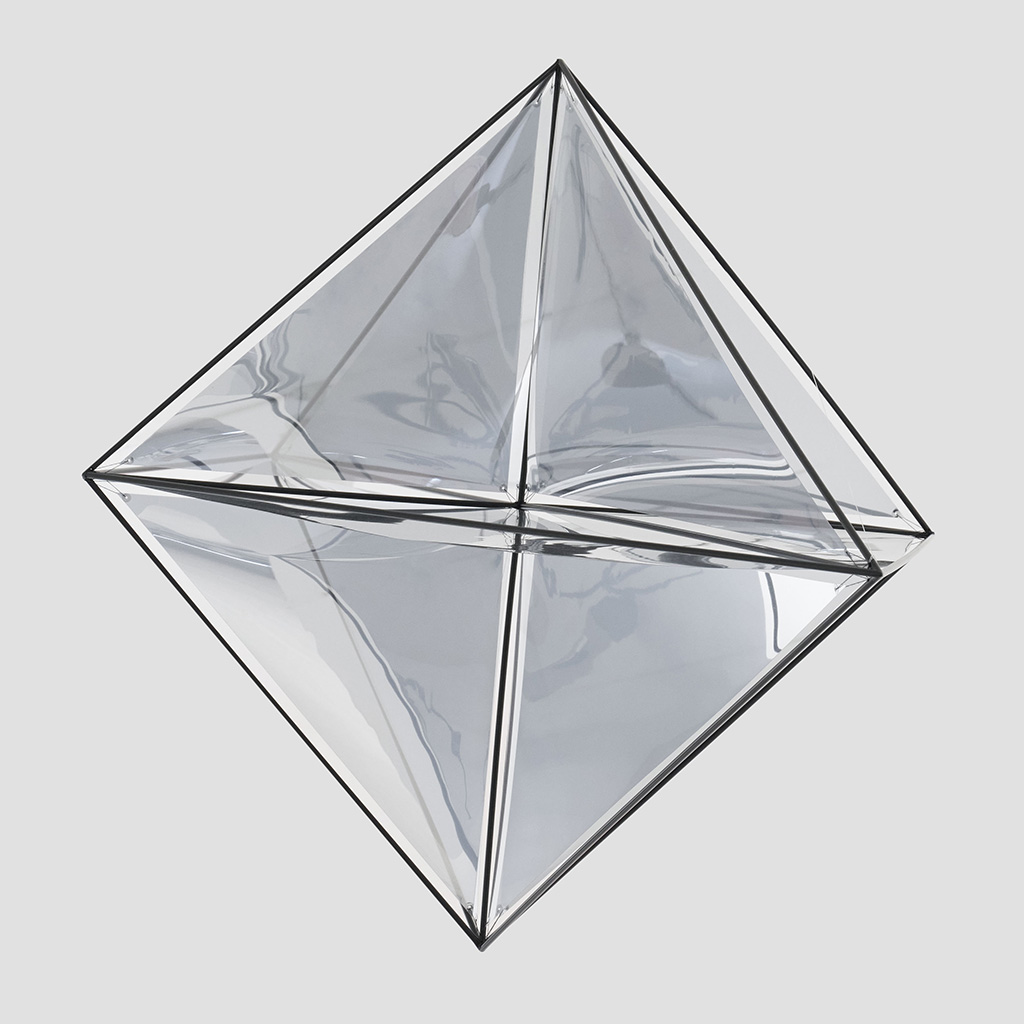
Palladium Variation #4’s lightweight, mirrorized, faceted structure is inspired by a history of objects built by military and intelligence agencies to spoof adversarial sensor systems. Objects like these are part of a broad category of military capacities called “Electronic Warfare.”
Electronic Warfare (EW) is a huge field with many aspects to it, but a large part of it has to do with developing technologies that allow someone to remotely influence or control adversarial sensor systems and hardware. The idea is to make those systems “see” what you want them to see and “do” what you want them to do.
There are a wide range of applications in EW including remotely disabling rival sensors, making objects appear, disappear, or behave erratically, and conjuring all sorts of digital illusions.
A small subset of the field has to do with building unusual objects – structures that to human eyes might look like a balloon or basketball, but that look to a radar operator like a fleet of bombers or a misbehaving UFO. The concept is related to stealth technology (creating shapes that are ‘invisible’ to radar), but much broader, namely creating objects that look like a huge range of things to sensor systems.
I often think about the relationship between the postwar aerospace industry and minimalist art. Undoubtedly, minimalist artists were inspired by the faceted shapes and then-exotic materials that emerged from advanced military research and development programs. But the philosophy of materials and shape descended from the Palladium programs are altogether different. They are not so much about the specificities of the objects-as-such. Quite the opposite. They are objects designed to dramatically amplify the different points-of-view that disparate observers and forms of seeing bring to them. They are adversarial sculptures, designed to weaponize the underlying assumptions built into different visual apparatuses.
This post is part of a series of posts supporting works from the exhibition You’ve Just Been Fucked by PSYOPS at Pace Gallery, New York.
You can find more information about this project and other posts in the series here.
For the last several years, I’ve been undertaking the most technically challenging photography series I’ve ever attempted: a project to photograph objects of unknown origin in orbit around the earth.
There are roughly 350 objects in orbit around the earth whose origins are unknown. These fall roughly into two categories: 1) Objects that the US Air Force tracks on radar and publishes orbital data for; 2) Objects that both amateur astronomers and foreign sources track and observe, but that the US military does not acknowledge, presumably because these unknown objects are classified.
UNKNOWN #89161 (Unclassified object near The Revenant of the Swan), 2023 Silver gelatin LE print 80 × 54 in.
The term “unid” is a term that amateur astronomers created to describe objects that they have observed in orbit, but whose identity they have failed to establish. In the first part of this text, I provide an overview of what we know about these objects, and review some attempts to identify them and their purpose. In the second part, I’ll describe some of the techniques I’ve used in my attempts to photograph them.
I.
What are Unids?
The short answer is, nobody knows. The longer answer is that for some objects, somebody probably knows something about some of them, but they’re not saying. Or, that also might be wrong and actually nobody knows.
Some background: The US Space Force’s 18th Space Defense Squadron, located at Vandenberg Space Force Base1 on the California coast north of Santa Barbara, is tasked with operating the US’ Space Surveillance Network. This is a global network of powerful radar systems, classified telescopes, space-based surveillance platforms, and other sensor networks. The squadron’s job is to identify and keep tabs on tens of thousands of objects in orbit around the earth. Over the course of their work, they regularly track and observe nearly 350 objects whose origin and identity are unknown. The 18th SDS catalogs these as “well tracked analyst objects.”
The “well-tracked analyst objects” are described by the surveillance squadron as “on-orbit objects that are consistently tracked by the U.S. Space Surveillance Network that cannot be associated with a specific launch. These objects of unknown origin are not entered into the satellite catalog, but are maintained using satellite numbers between 80000 and 89999.” (In the military satellite catalog, satellites are cataloged sequentially, i.e. the rocket that launched Sputnik is catalog entry #1, Sputnik is entry #2, etc.)
Orbital Elements for Unknown Objects (Paglen Studio)
So what are these objects? The best answer is that, well, nobody knows. A more fine-grained answer involves some informed speculation. It is unlikely, however possible, that some of these objects are natural phenomena such as wayward asteroids. Undoubtedly, most of these “unknowns” are unidentified debris from satellite launches in places or times where the Air Force’s tracking capabilities are limited. But the story is almost certainly far more complicated.
The US’ National Reconnaissance Office (NRO) has a history of building satellites that attempt to disguise themselves as pieces of debris. This was the case for example with a spacecraft called “USA 53” (deployed from the Space Shuttle in 1990) that faked its own explosion, and again in 1999 when another “stealth” satellite deployed a balloon-like structure as a decoy. The Russian military has engaged in similar tactics, most recently with a spacecraft called Kosmos 2499, which behaved as if it were a debris object but which was almost certainly a satellite designed to attack other satellites. (Kosmos 2499 was mysteriously destroyed in early 2023, creating a small debris field.)
Visualization of Unknown Object Orbits (Paglen Studio)
Analyzing Unids The only publicly available analysis of the “well-tracked analyst objects” that I’m aware of comes from a PhD dissertation written by space-security researcher James Pavur at the University of Oxford. Pavur took a novel approach to the analysis of these objects. He created a dataset of known satellites, and another dataset of known debris objects, and then trained a machine learning model on each. His idea was to build a classifier that could distinguish between a “generic satellite” and “generic debris object.” Pavur then used those models to analyze the orbit of Kosmos 2499, a satellite that pretends to be a debris object. His model correctly predicted that Kosmos 2499 was a satellite, not a piece of debris. Pavur then ran his model on the entirety of the “well-tracked analyst objects” data and discovered something remarkable: the model predicted with high confidence that a non-trivial number of unknown objects behaved, in fact, like spacecraft.
Excerpt from James Pavur’s dissertation “Securing new space: on satellite cyber-security” (2021)
Almost immediately after the publication of his dissertation, Pavur was tapped to work for the Department of Defense and is unable to speak about his current work. However, Pavur did provide me with a copy of the models he used in his analysis and I’m conducting a review of them to see if there’s more to learn about “analyst objects” from his work.
There are, however, a few limitations to Pavur’s approach. Firstly, Pavur’s classifier wasn’t designed to detect station-keeping maneuvers. Operational satellites in low-earth orbit are affected by small amounts of atmospheric drag in the upper atmosphere that slowly bring them back down to earth. To counter this, a satellite has to periodically “boost” itself back into its desired orbit using small thrusters located on the spacecraft. Satellites in higher orbits are affected by the gravitational influence of the moon, and from the uneven nature of Earth’s gravity field.2
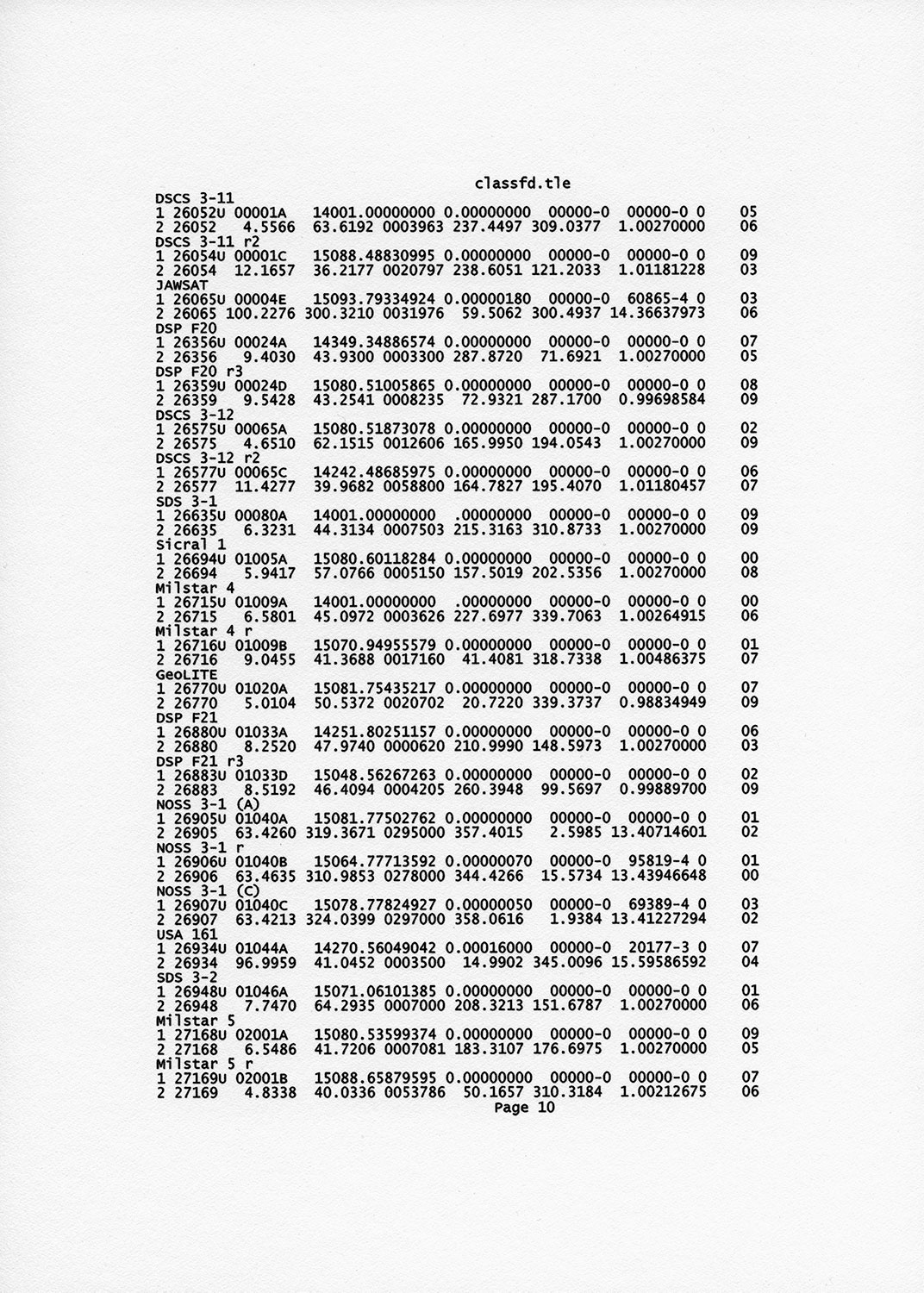
The Plot Thickens… In addition to objects in the 18th Space Defense Squadron’s publically available data, there are two additional sources of information about unknown objects. The first is a hybrid Russian civilian/military tracking program called “ISON” (International Scientific Observer Network), and the second is a database of classified objects maintained by a network of amateur satellite observers, unofficially known as the “See-Sat” group. Both of these groups have identified a handful of unknown objects in orbit whose existence is classified by the American military – in other words Top-Secret unknown objects.
Classified Unknown Objects in Earth Orbit (Paglen Studio)
So, to recap: There are many hundreds of unknown objects in orbit around the earth, many of which are tracked and acknowledged by the US military. Researchers who’ve analyzed these objects have concluded that a non-trivial number of them display characteristics more consistent with spacecraft than debris objects, although these results require further study. What’s more, there are more than a dozen other objects that are also “unknowns” but whose existence is classified and whose orbits are undisclosed.
II.
Production documentation (Paglen Studio)
Photographing Unids Photographing these objects is extremely difficult in every way, but can be done using good data, accurate modeling, and very specific optical equipment.
Step 1: Get the Data The first thing one needs to photograph unids is a good source of data. I use two sources: two-line elements (a file format for describing satellite orbits) for “well-tracked analyst objects” are readily available by creating an account with “The Space Force,” on their portal for satellite information at space-track.org. This database provides a list of unclassified data. To retrieve data about classified unknown objects, the best source is a website maintained by satellite observer Mike McCants, who coallates observations from amateur satellite observers and publishes orbital elements based on those observations. Those elements need to be downloaded and filtered for both “unknown” objects and “ISON” objects.
Research documentation (Paglen Studio)
Step 2: Model the Orbits Then I import that data into two different virtual planetarium software environments. (I use two in order to ensure that my predictions are accurate across multiple models and that I haven’t made a mistake). The first software I use is Stellarium (this is a superb piece of free astronomy software). To check my work, I load the same data into a second modeling program called Heavensat.
Using the modeling software, I can make predictions about when and where in the sky I might find a particular object.
It takes the better part of the day to model these orbits, and to select a series of targets for a given evening. Once I’ve selected the objects I want to image, I write a script for the evening in a software package I use to control the telescope, mount, and camera. The script tells the telescope to point to a particular point in the sky at a very precise moment, then instructs the camera to start making exposures before, during, and after the predicted pass of the unknown object. If I do everything correctly, I am able to capture the light-trail of the object as it passes through the telescope’s field-of-view.
Step 3: Equipment The main difficulty in choosing an appropriate telescope for photographing unids is sourcing a telescope that can collect as much light as quickly as possible. Because unids tend to be both very faint and fast-moving, I use the “fastest” telescope that I can. In my case, that means a Rowe-Ackermann Schmidt Astrograph (RASA) astrograph.
The RASA design is designed above all for speed, but it sacrifices ease and multifunctionality to get there. The design is a variation on a Schmidt-Cassegrain Telescope that replaces the secondary mirror with a camera sensor. The advantage of this is that the telescope can collect far more light much faster than a telescope with a secondary mirror. There are, however, many disadvantages. First, the removal of the secondary mirror means that there is no possibility of including an eyepiece in the design – there is no way to look through the telescope and it can only be used with a specialized camera. Secondly, at f/2 the critical focus zone (known as “depth of field” in ‘normal’ photography) of the telescope is smaller than half the width of a human hair. This translates into extreme technical difficulties in positioning the camera sensor accurately, as slight imperfections in how the camera sensor is placed in its housing during the manufacturing process create optical anomalies that have to be manually compensated for. This process is not fun.
On any given night, I’m aiming for triple-redundancy: for each image I am using three separate telescopes to collect as much light as possible and to mitigate against any mechanical failures (which happen often).
When I’ve successfully photographed the light-trail of a unid, I task the telescopes with collecting additional data from that region in the sky to fill out the photograph. Each exposure ends up being about 10,000 seconds worth of data or about 3 hours, much of which is shot with an infrared filter to highlight the various stelliferous and gaseous regions in the sky that are invisible to our eyes.
Gustav Dore, The stormy blast of hell with restless fury drives the spirits on, c1890.
The night sky looks very different to infrared-sensitive equipment than it does to unaided eyes. Hydrogen, sulfur, and oxygen emissions reveal great cosmic clouds, stellar remnants, and galactic structures that recall Gustav Dore’s etchings of the Divine Comedy. Their names refer to ancient myths, stories, and ancestral star-gazers. Many of the stars in the sky have names so ancient that their origins of those names, and the stories they once referred to, have been long forgotten.
I have spent countless days and nights studying the unknown objects, plotting orbits, measuring light curves, and analyzing their movements over time to see how their behavior may have changed over the years. I’ve tried to learn anything and everything I can about their shape, size, and mass, the relative stability of their orbits, and the question of whether they receive energy from any non-natural sources. Some of the numbers are surprising.
But every analytical technique available supplies only tiny variations on a simple fact: the identity of these objects is “unknown.” Given this, I ask myself where my desire to “identify” them comes from. Where does my unconscious desire to place these objects into received categories come from? Why does my subconscious seek the comfort of pre-existing language and concepts in the face of these unknowns?
This post is part of a series of posts supporting works from the exhibition You’ve Just Been Fucked by PSYOPS at Pace Gallery, New York.
You can find more information about this project and other posts in the series here.
Footnotes
1I’m sorry I really have a hard time saying or writing the words “Space Force.” (Back)
2 Gravitational anomalies are areas on Earth where the local gravity field is stronger or weaker than the global average. These variations can be caused by differences in the density of the Earth’s crust, the presence of large mountain ranges or ocean trenches, and variations in the distribution of the Earth’s mass. One of the most well-known gravity anomalies is the “Indian Ocean Geoid Low,” which is a region of low gravity field strength in the Indian Ocean. This anomaly is primarily due to the large mass of the Himalayas to the north and the Earth’s equatorial bulge. Gravitational anomalies affect satellites by subtly altering their inclination over time, and by causing them to drift longitudinally. (Back)
I think about clouds a lot. They’re really strange things – on one hand, humans have gone to great lengths to characterize different kinds of clouds, creating intricate cloud atlases and taxonomies. On the other hand, when we look at clouds we tend to imagine them taking different shapes – faces, animals, and whatnot. And of course, Alfred Stieglitz’ photographs of clouds are widely narrated as some of the first examples of abstraction in photography.
CLOUD #735 Scale Invariant Feature Transform; Region Adjacency Graph; Watershed, 2019 Dye sublimation print 48 × 66 in.
As part of my ongoing study of how computer vision and AI systems “see” the world, I have a series of works that look at clouds through the “eyes” of various computer vision algorithms. The cloud formations shown in these works are overlaid with strokes and lines depicting what various computer vision algorithms are “seeing” in the images. Different algorithms are designed to look for faces, unique key points, lines, circles, areas of interest, and are attempting to simplify the underlying photograph into a series of sections.
These algorithms used in this series of works are found in technologies such as guided missiles and drones, autonomous surveillance systems, self-driving cars, facial recognition, 3-D modeling, and in many other computer vision contexts.
CLOUD #865 Hough Circle Transform, 2019 Dye sublimation print 60 × 48 in.
When I was working on the Landing Sites images, it occurred to me that if one were to literally “dive into” the seascapes that I was making images of, one should theoretically be able to see the actual material conjunctions of internet cables that I was trying to learn how to “see.”
Bahamas Internet Cable System (BICS- 1) NSA/GCHQ-Tapped Undersea Cable Atlantic Ocean, 2015 C-Print 60 × 48 in.
NSA-Tapped Undersea Cables, North Pacific Ocean, 2016 C-Print 48 × 72 in.
To do this project, I learned how to scuba-dive, learned a little bit of bathymetry and underwater navigation, and started thinking about and practicing some conceptual approaches to underwater photography.
Americas II NSA/GCHQ-Tapped Undersea Cable Atlantic Ocean, 2015 C-Print 48 × 60 in.
To locate these cables under the oceans, I had to find places that met a couple of criteria: they had to be at a reasonable depth (not more than around 120’), in places where the water would be relatively clear, and places where the cables wouldn’t be buried under sand. This led me to zero in on a handful of sites in Florida, Hawaii, Guam, and Australia.
This is an ongoing project to track and photograph the world of secret satellites that are above our heads nearly constantly.
Dead Satellite with Nuclear Reactor, Eastern Arizona (COSMOS 469), 2011 C-Print 48 × 60 in.
Discarded Rocket Body Approaching the Disk of the Moon (SL-8 R/B), 2012 C-Print 48 × 42 in.
PAN (Unknown; USA-207), 2010 C-Print 60 × 48 in.Singleton/SBWASS-R1 and Three Unidentified Spacecraft (Space Based Wide Area Surveillance System; USA 32), 2012 C-Print 60 × 48 in.INTRUDER 12A in Vulpecula (Ocean Reconnaissance Satellite; USA 274), 2017 Dye sublimation print 60 × 48 in.
Although the satellites I track and photograph in this series are not typically acknowledged by the United States, they are cataloged and observed by an international network of amateur “satellite observers,” whose observations I use to calculate the position and timing of overhead transits.
To make the images, I use a wide range of cameras, telescopes and computer-guided mounts to achieve the positional and temporal accuracy that’s required.
Classified TLEs
Production documentation
Star chart
For an insight into the kinds of work that amateur satellite-spotters do, take a look at the website of my friend Marco Langbroek.
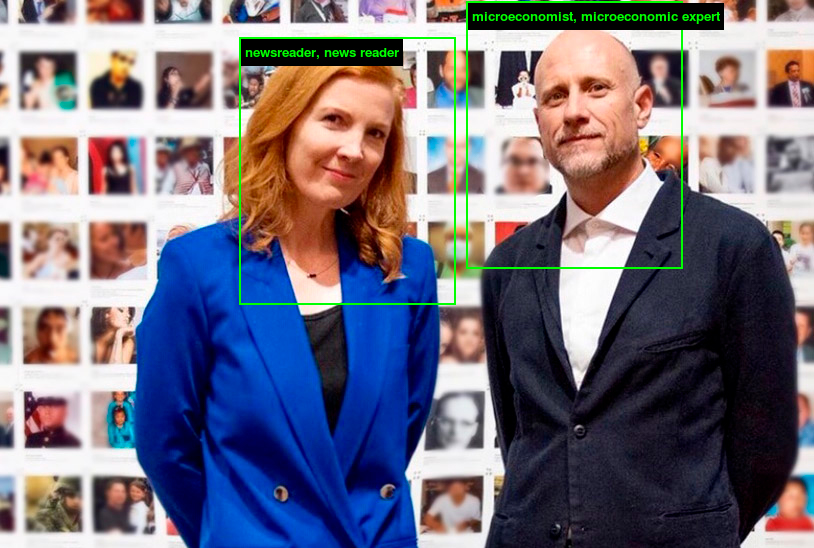
ImageNet Roulette was part of a broader project to draw attention to the things that can – and regularly do – go wrong when artificial intelligence models are trained on problematic training data.
Kate Crawford and Trevor Paglen use the ImageNet Roulette tool.
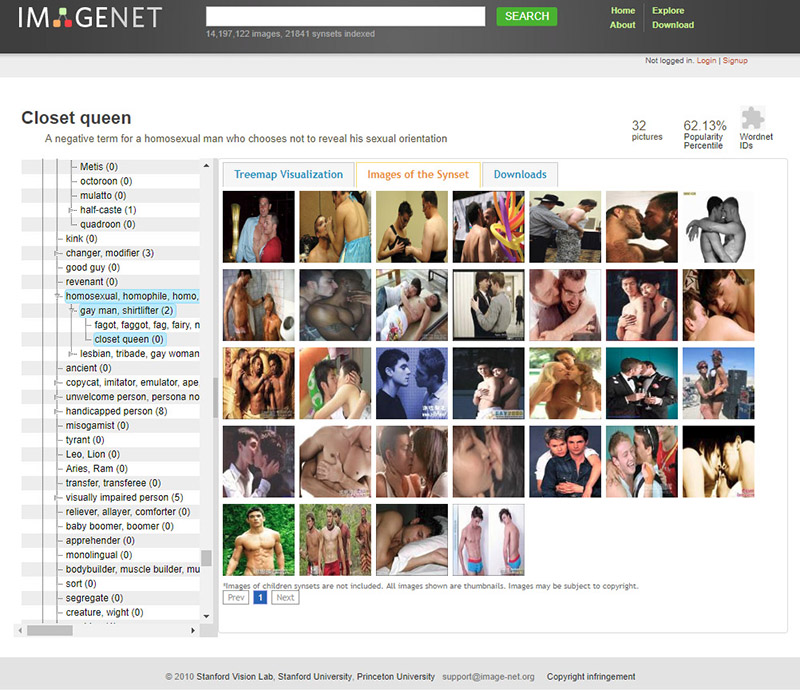
ImageNet Roulette is trained on the “person” categories from a dataset called ImageNet (developed at Princeton and Stanford Universities in 2009), one of the most widely used training sets in machine learning research and development.
The project was a provocation, acting as a window into some of the racist, misogynistic, cruel, and simply absurd categorizations embedded within ImageNet and other training sets that AI models are build upon. My project lets the training set “speak for itself,” and in doing so, highlights why classifying people in this way is unscientific at best, and deeply harmful at worst.
Selections from the “Person” classes, ImageNet
Selections from the “Person” classes, ImageNet
Selections from the “Person” classes, ImageNet
Selections from the “Person” classes, ImageNet
Selections from the “Person” classes, ImageNet
Excavating AI is my article, co-authored with Kate Crawford, on ImageNet and other problematic training sets. It’s available here.
ImageNet Roulette currently only exists as an installation in museums and galleries – its online incarnation has been taken down.
Kate Crawford and I were invited by Prada Mode to create an exhibition and cultural program at the iconic Maxim’s restaurant in Paris. We transformed the space into a story about the history of facial analysis and a reminder of the dark histories from which contemporary facial recognition systems emerge. Pages from 19th Century phrenology and physiognomy textbooks were shown in relation to collections of historical mugshots, “training images” used for facial recognition software development, and patent applications showing contemporary approaches towards facial measurement.
Installation view, Making Faces, 2020.
Installation view, Making Faces, 2020.
Panel discussion during Making Faces, 2020.
Installation view, Making Faces, 2020.
Installation view, Making Faces, 2020.
More information about the event and a short interview with Kate and myself is here.