89 Landscapes is a dual-channel video installation comprising material I filmed for Citizenfour, Laura Poitras’ Academy Award-winning film about Edward Snowden.
The installation presents a series of landscapes, all of which have some kind of intrinsic relationship to the NSA’s mass surveillance infrastructures.
89 Landscapes, 2015 Video stills 2-channel color video projection 5.1 dolby surround sound Projection size: 354 ⅜ × 98 ⅜ in. 24 min
89 Landscapes, 2015 2-channel color video projection 5.1 dolby surround sound Projection size: 354 ⅜ × 98 ⅜ in. 24 min Installation view at Metro Pictures, New York, 2015
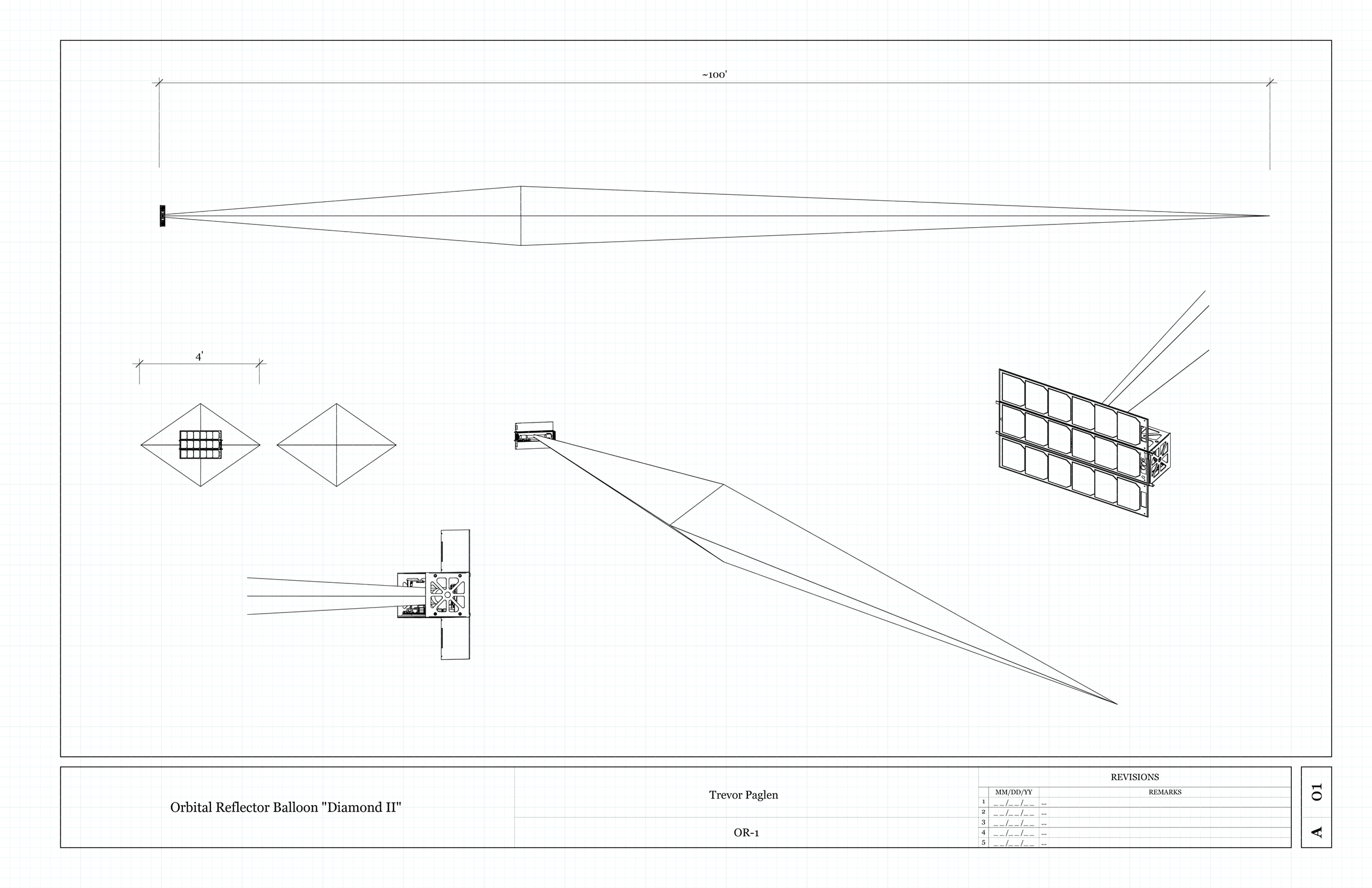
Produced in collaboration with the Nevada Museum of Art, Orbital Reflector is a sculpture constructed of a lightweight and highly-reflective polyethylene material housed in a small box-like satellite bus. The satellite was meant to be inserted into orbit and after a few days deploy the reflective structure, creating a 100m long diamond-shaped mirror to reflect sunlight down to earth below. From earth, the sculpture would have appeared like a slowly moving artificial star as bright as a star in the Big Dipper.
Digital Rendering of Orbital Reflector, 2018Technical drawing of Orbital Reflector, 2018
Production documentation of Orbital Reflector, 2018.
Production documentation of Orbital Reflector, 2018.
Production documentation of Orbital Reflector, 2018.
Production documentation of Orbital Reflector, 2018.
Orbital Reflector ultimately fell victim to the 2018/2019 government shutdown Donald Trump instigated in an attempt to coerce congress into funding a wall between the US and Mexico.
Launch of SSO-A Mission at Vandenberg Air Force Base, 2018
Some of my writings on Orbital Reflector are here and here.
The “nonfunctional satellites” are sculptures designed to be placed into low-earth orbit where they will appear as bright points of light slowly moving across the sky to viewers on earth’s surface. They are designed to last for only a few weeks before burning up in the atmosphere. Developed in collaboration with aerospace engineers, the designs combine maximum reflectivity and surface area with minimum weight.
Prototype for a Nonfunctional Satellite (Design 4; Build 4), 2013 Mixed media 16 x 16 x 16 feet Installation test at Hangar, Nevada, 2013Installation test of Prototype for a Nonfunctional Satellite at Hangar, Nevada, 2013
These designs are responses to the question of what aerospace engineering would look like if its methods were decoupled from the corporate and military interests underlying the industry. The nonfunctional satellite recasts the old question of “art for art’s sake” within a different context, asking whether we can imagine something like “aerospace engineering for aerospace engineering’s sake.” As such, the spacecraft is a kind of “impossible object” that works as both a critique of the militarization and commercialization of the night sky, and a way to imagine how things could be different.
Prototype for a Nonfunctional Satellite (Design 4; Build 3), 2013 Mixed media 12 x 12 x 12 feet Installation view at Protocinema, Istanbul, 2013
Prototype for a Nonfunctional Satellite, 2014 Mixed media Dimensions variable Installation view at BALTIC Centre for Contemporary Art, Gateshead, 2015.Prototype for a Nonfunctional Satellite (Design 4, Build 2), 2015 Mixed media 18 x 18 x 2 feet Installation view at Eli and Edythe Broad Art Museum at Michigan State University, East Lansing, 2015
As part of a larger project looking at the material infrastructures of the internet and mass surveillance, I located and photographed some of the primary “choke points” on the internet backbone – places where multiple undersea cables reach land and connect the continents together.
NSA-Tapped Fiber Optic Cable Landing Site, Morro Bay, California, United States, 2015 C-Print and mixed media on navigational chart C-Print image: 48 × 60 in.; Map image: 48 × 56 ⅞ in.
Detail of NSA-Tapped Fiber Optic Cable Landing Site, Morro Bay, California, United States, 2015
Detail of NSA-Tapped Fiber Optic Cable Landing Site, Morro Bay, California, United States, 2015
Detail of NSA-Tapped Fiber Optic Cable Landing Site, Morro Bay, California, United States, 2015
Detail of NSA-Tapped Fiber Optic Cable Landing Site, Morro Bay, California, United States, 2015
Detail of NSA-Tapped Fiber Optic Cable Landing Site, Morro Bay, California, United States, 2015
NSA-Tapped Fiber Optic Cable Landing Site, Tanguisson Beach, Guam, 2016 C-Print and mixed media on navigational chart C-Print image: 48 × 60 in.; Map image: 65 × 48 in.
Detail of NSA-Tapped Fiber Optic Cable Landing Site, Tanguisson Beach, Guam, 2016
Detail of NSA-Tapped Fiber Optic Cable Landing Site, Tanguisson Beach, Guam, 2016
Detail of NSA-Tapped Fiber Optic Cable Landing Site, Tanguisson Beach, Guam, 2016
Detail of NSA-Tapped Fiber Optic Cable Landing Site, Tanguisson Beach, Guam, 2016
Each photograph had two “rules”: first, the conjunction of internet cables had to be within the image’s frame; second, the horizon line is in the center of the image. These are probably the most abstract images I have ever made for the simple reason that the infrastructures I’m trying to photograph are generally nowhere to be seen in the images themselves – the cables I’m ostensibly photographing are underwater and under the beaches.
NSA-Tapped Fiber Optic Cable Landing Site, New York City, New York, United States, 2015 C-Print and mixed media on navigational chart C-Print image: 48 × 60 in.; Map: 48 × 58 ½ in.
Detail of NSA-Tapped Fiber Optic Cable Landing Site, New York City, New York, United States, 2015
For another series of photographs, I learned how to scuba dive and literally and figuratively ‘dove into’ these landscapes to find the internet’s undersea cables.
Autonomy Cube is a sculpture designed to be housed in art museums, galleries, and civic spaces. The sculpture is meant to be both “seen” and “used.” This happens in several ways. Internet‐connected computers housed within the work create an open Wi‐Fi hotspot called “Autonomy Cube” wherever it is installed. Anyone can join this network and use it to connect to the Internet.
Autonomy Cube does not provide a normal internet connection. The sculpture routes all of the Wi‐Fi traffic through the Tor network, a global network of thousands of volunteer‐run relays designed to help anonymize data. In addition, Autonomy Cube becomes a part of the Tor network and relays Tor traffic, and is used by Tor users around the world to anonymize their internet use. When Autonomy Cube is installed, both the sculpture, host institution, and users become part of a privacy‐oriented, volunteer run internet infrastructure.
Autonomy Cube was shown at The Edith-Russ-Haus for Media Art in 2015, where the sculpture was for the first time configured as an exit node so it can be used worldwide and with repeaters traversing the exhibition space, turning the entire house into an Autonomy Cube that radiates into the city of Oldenburg and beyond.
Autonomy Cube, 2015 Plexiglas cube, computer components 19 ⅝ × 19 ⅝ × 19 ⅝ in. Installation view at Edith-Russ-Haus Für Medienkunst, Oldenburg, 2015.
There is also a publication on the Autonomy Cube in relation to the above mentioned exhibition. In the book, two commissioned essays provide critical reading of the Autonomy Cube project – the art historian Dr. Luke Skrebowski positions the piece in the history of institutional critic, meanwhile architect and urbanist Keller Easterling tackles it with its political potential.
If you want to learn more about Tor, check out these links:
For a 2019 commission in the Barbican’s Curve Gallery in London, I took a close look at the most widely-used “training set” used in AI – ImageNet, a database of over 14 million images organized into more than twenty-thousand categories.
The installation was made out of approximately 30,000 individually printed photographs, showing the precarious relationships between images and labels in a kind of extended homage to Magritte’s “Treachery of Images” for the age of machine learning.
Installation view, From ‘Apple’ to ‘Anomaly’ (Pictures and Labels) – Selections from the ImageNet dataset for object recognition, Barbican Centre – The Curve, London (September 2019 – February 2020)Installation view, From ‘Apple’ to ‘Anomaly’ (Pictures and Labels) – Selections from the ImageNet dataset for object recognition, Barbican Centre – The Curve, London (September 2019 – February 2020)Installation view, From ‘Apple’ to ‘Anomaly’ (Pictures and Labels) – Selections from the ImageNet dataset for object recognition, Barbican Centre – The Curve, London (September 2019 – February 2020)Installation view, From ‘Apple’ to ‘Anomaly’ (Pictures and Labels) – Selections from the ImageNet dataset for object recognition, Barbican Centre – The Curve, London (September 2019 – February 2020)
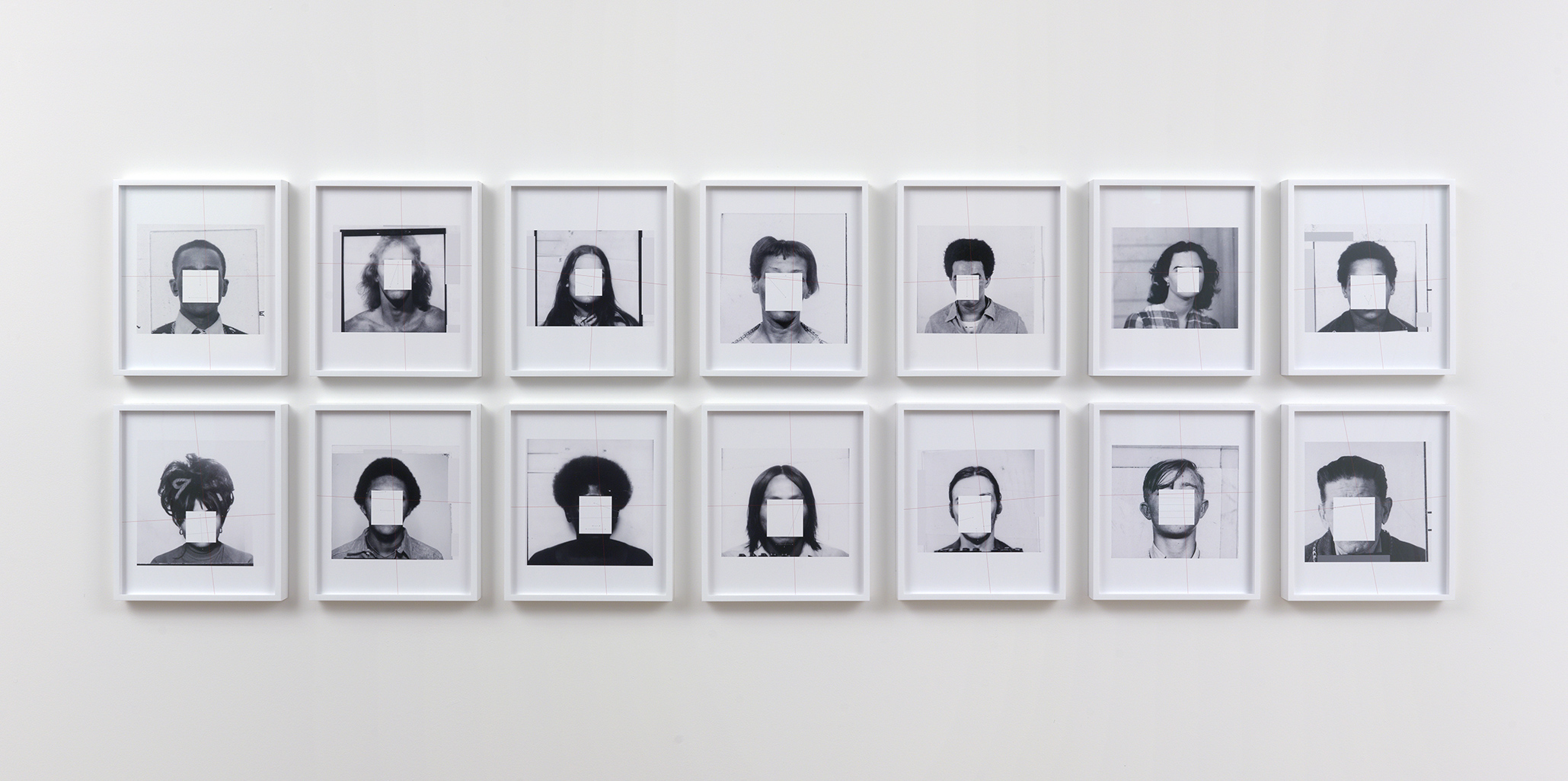
They Took the Faces from the Accused and the Dead…, 2019. Set of 14 pigment prints Each: 11 ½ × 13 ½ in. Installation view, The Shape of Clouds at Pace Gallery, Geneva, 2019.
Contemporary facial-recognition algorithms were first properly researched in the early 1990s. To conduct that research, computer scientists and software engineers need large collections of faces to experiment with and to use as performance benchmarks. Before the advent of social media, a common source of faces for this research and development came from mugshots of accused criminals and prisoners. Photos of prisoners are supplied by the American National Institute of Standards (the agency responsible for weights and measures) to researchers across the world developing facial recognition technologies. In a very real sense, facial recognition software is built upon the faces of the accused and the dead.
They Took the Faces from the Accused and the Dead… (#00520_1_F), 2019 Pigment print 50 × 42 in.
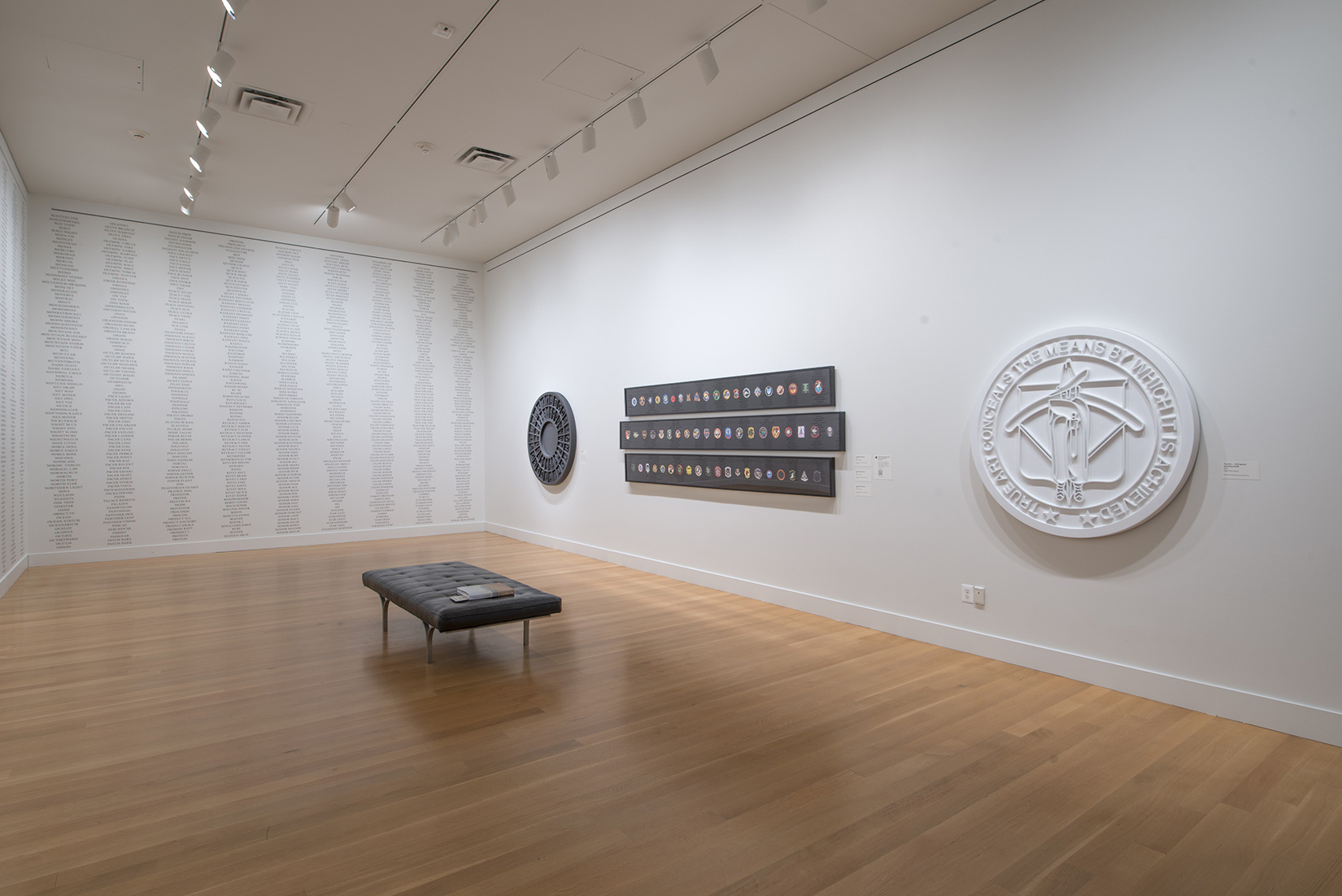
A large wall piece of training images is included in the exhibition ‘Uncanny Valley: Being Human in the Age of AI‘, which was commissioned by the de Young Museum in San Francisco.
Exhibition view of Uncanny Valley: Being Human in the Age of AI, de Young Museum, San Francisco, 2020. Photograph by Randy Dodson. Image courtesy of the Fine Arts Museum of San Francisco. Exhibition view of Uncanny Valley: Being Human in the Age of AI, de Young Museum, San Francisco, 2020. Photograph by Randy Dodson. Image courtesy of the Fine Arts Museum of San Francisco.
There is also a publication about the exhibition, if you want to learn more.
While photographing and shooting a video of NSA infrastructures in Germany for Laura Poitras’ film Citizenfour, I was stopped and interrogated by police and military on a nearly daily basis. Although what I was doing was perfectly legal, the military still insisted on harassing me while I was doing my job. My response was to dream up the Eagle-Eye Photo Contest, an amateur photography contest to take place in Germany to see who could take the most interesting pictures of NSA bases in continental Europe.
Trevor Paglen production image.
I partnered with Franziska Nori at the Frankfurter Kunstverein and we launched the contest. Over a hundred photographers participated.
Call for submissions for Eagle-Eye Photo Contest at Frankfurter Kunstverein. Image: NSA/GCHQ Surveillance Base, Bude, Cornwall, UK, 2014
Award ceremony at Frankfurter Kunstverein for winners of Eagle-Eye Photo Contest. Photo: Uwe Dettmer
I conceptualized this exhibition with Kate Crawford to tell a story about the history of images used to ‘recognize’ humans in computer vision and AI systems. We weren’t interested in either the hyped, marketing version of AI nor the tales of dystopian robot futures. We wanted to engage with the materiality of AI, and to take those everyday images seriously as a part of a rapidly evolving machinic visual culture. That required us to open up the black boxes and look at how these ‘engines of seeing’ currently operate.
Exhibition view of Kate Crawford | Trevor Paglen: Training Humans Photo: Marco Cappelletti; Courtesy Fondazione Prada
The result was the Training Humans exhibition – a show that looks at the “training images” used in Artificial Intelligence as a kind of vernacular photography, but at the same time as a kind of image-infrastructure underlying more and more digital platforms.
Here is more information on the exhibition and there is also a nice publication contextualizing the installation.
Exhibition view of Kate Crawford | Trevor Paglen: Training Humans Photo: Marco Cappelletti; Courtesy Fondazione PradaExhibition view of Kate Crawford | Trevor Paglen: Training Humans Photo: Marco Cappelletti; Courtesy Fondazione Prada
Installation view, Trevor Paglen: Sites Unseen, 2018, Smithsonian American Art Museum, Washington, DC. Photo by SAAM
Sites Unseenwas a major solo exhibition at the Smithsonian American Art Museum curated by John P. Jacob, where I presented my early photographic series alongside more recent sculptural objects and new work with AI. With this exhibition I continued my contribution to the ongoing conversation about privacy and surveillance in contemporary society.
Installation view, Trevor Paglen: Sites Unseen, 2018, Smithsonian American Art Museum, Washington, DC. Photo by SAAM
There was also a publication produced alongside the exhibition authored by John P. Jacob, with contributions by Luke Skrebowski.